
0160. Intersection of Two Linked Lists (Easy)
Question
Write a program to find the node at which the intersection of two singly linked lists begins.
For example, the following two linked lists:
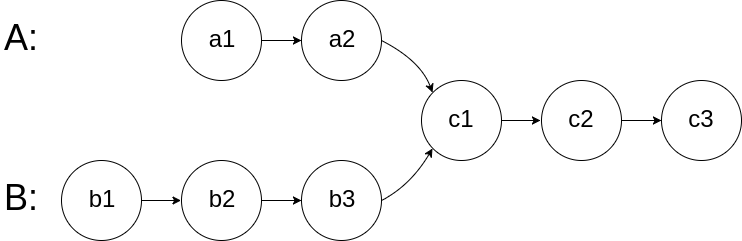
begin to intersect at node c1.
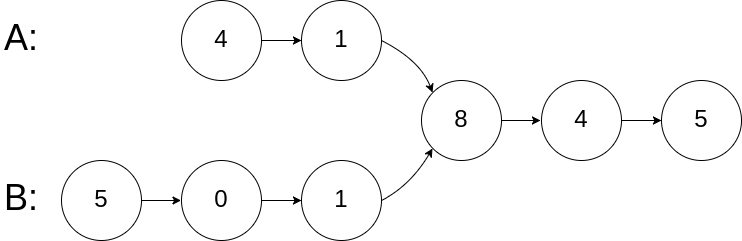
Example 1
| |
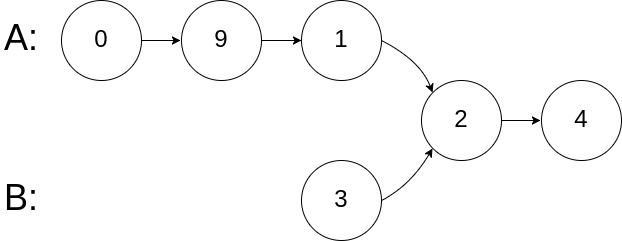
Example 2
| |
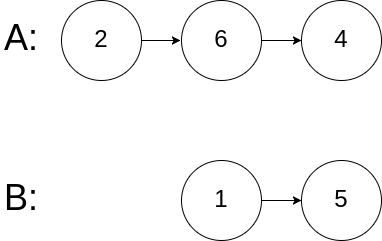
Example 3
| |
Notes:
- If the two linked lists have no intersection at all, return
null. - The linked lists must retain their original structure after the function returns.
- You may assume there are no cycles anywhere in the entire linked structure.
- Your code should preferably run in O(n) time and use only O(1) memory.
分析/解題
有兩個單向連結串列,試找出其交會開始的節點。
如果它們彼此之間沒有相交,則回傳null。
(注意中提到最好時間使用O(n)且空間僅使用O(1)。)
這題其實相當簡單,但要特別留意一點:
就算兩個節點的值相等,也並不代表它們是同一個節點。
從Example 1中就可以看到這個例子,
節點值都是1,但並非同節點,這部分要特別留意。
不過我們並未特別針對ListNode去實作相等的function的狀況下,
直接用**==** 判斷即可。
那麼,怎麼來找共同的交會節點呢?
我們可以先假設它們有一個交會點,
那麼list A跟list B在這個交會點(含)以後的節點數會相等。
(因為重合了XD)
所以比如說A總長度是9,B總長度是6,
我們可以先讓A從開頭走3步 ,(這樣才能對齊 )
接著兩邊開始依序走訪比對走到的節點是否交會,
若交會則回傳;若走到底還沒有看到相同的節點,
則回傳null(或None)。
所以大體上的操作如下:
- 設定iteA/iteB作為走訪list A/list B用的節點
- 先各自走訪過一輪來取得A和B分別的長度
- 長度相減,讓比較長的list的起始節點先多走相差的節點數
- 同時開始第二次的走訪,一邊比對節點是否交會,
是則回傳該節點,不是則走到至少一邊走完為止 - 若4走完尚未回傳則回傳null(表示沒有交會)
寫成程式碼如下。
Java
Python的部分可以寫得稍微簡潔一點,
留意用來遞進用的迴圈這裡的for會使用單底線,
因為我們只想要使用重複diff或-diff次的功能,
並不在意迴圈執行到第幾次。
Python
面試實際可能會遇到的問題
「時間/空間複雜度?」
(O(N), O(1),我們共遍歷了最多兩次的list,
且只有額外使用到幾個輔助用的節點和變數。)
相似及延伸
1.0599. Minimum Index Sum of Two Lists
Special Thanks suggestions/corrections from viewers:
(歡迎提供意見協助更正歐~)
從LeetCode學演算法,我們下次見囉,掰~