
0563. Binary Tree Tilt (Easy)
寫在前面
抽獎活動還在繼續累積人數(現在好像沒有人想抽XD)
在Python Taiwan的連結第100篇的文章 底下,
公開分享到你的臉書、按讚該篇文章、並留言告訴我說,
「你最喜歡這一整個系列的哪一篇?為什麼?」或
「除了從LeetCode學演算法系列以外,
你還想要看到關於什麼方向的文章?」
超過20則留言的話 (有完成以上步驟的才算),我們就抽一組
「從Leetcode學演算法|進階篇」+「從Leetcode學演算法|面試篇」
課程的免費兌換券進行贈送!
期限嘛…就延長到滿人數吧XDD (不然也沒辦法哈哈)
容筆者工商一下,
「從Leetcode學演算法|進階篇」 開放預購啦!
這次選了40道難度加深的LeetCode題目,
同樣也會細部解說對應的技巧及須要掌握的演算法!
同時這次購買進階篇的話,
額外還加贈**「從Leetcode學演算法|面試篇」** !
當中包含了面試準備須知分享 ,及訪談國內外不同經驗的工程師 ,
讓你不論是想走前端/後端/一般軟工 或者是想找國外的工作 ,
是初學想轉職 還是正在工作 ,都能夠從中得到收穫呦!
有興趣的朋友可以使用下面的早鳥優惠~
「從Leetcode學演算法|進階篇」+「從Leetcode學演算法|面試篇」 :
https://bit.ly/leetcodeadv
「從Leetcode學演算法」全套(基礎/進階/面試篇)同捆優惠:
https://bit.ly/leetcodeall
Question
Given the root of a binary tree, return the sum of every tree node’s *tilt *.
The tilt of a tree node is the ** absolute difference** between the sum of all left subtree node ** values** and all right subtree node ** values**. If a node does not have a left child, then the sum of the left subtree node ** values** is treated as 0. The rule is similar if there the node does not have a right child.
Example 1
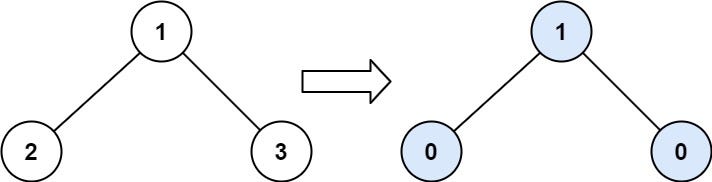
| |
Example 2
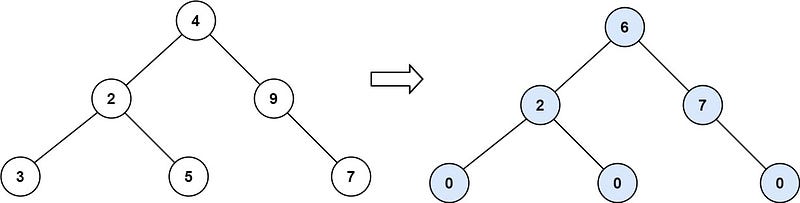
| |
Example 3
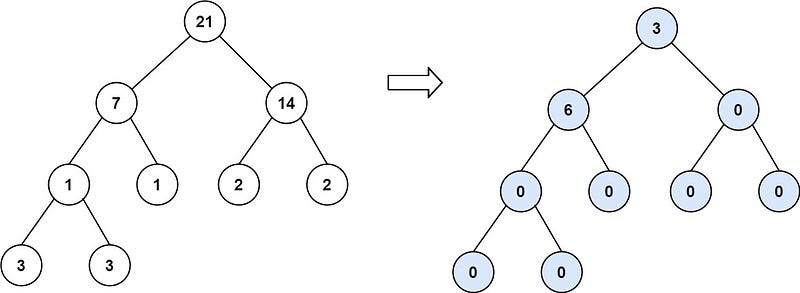
| |
Constraints
- The number of nodes in the tree is in the range
[0, 104]. -1000 <= Node.val <= 1000
分析/解題
給定一個二元樹,試計算二元樹的每個節點的tilt(坡度)和。
什麼是tilt呢?
題目告訴我們,對於一個節點,
其左子樹的和以及右子樹的和相減的絕對值,
就稱為它的坡度(tilt),當子樹不存在時,和則視為0。
另外由於整個樹的總節點數已經被限定在0~104之間了,
表示我們可以放心的用遞迴!
那麼,我們該怎麼對每個節點算坡度呢?
對於一個節點n,如果它不存在的話(NIL),
其坡度自然為0,且總和同樣為0 ;
存在的話,我們必須先算出左子樹(n.left為根節點的子樹)和,
以及右子樹(n.right為根節點的子樹)和,將兩者相減取絕對值,
就是n的坡度。
因此,我們可以使用一個dfs的函式來同時處理算子樹和,
以及坡度的部分,整個dfs的概念應該會如下:
- 若n為NIL,回傳0
- 將n.left代入dfs中,取得n.left的子樹和l
- 將n.right代入dfs中,取得n.right子樹和r
- 將|l-r|加到物件變數的答案res中
- 回傳l+r+n.val
留意到我們使用dfs的回傳一直都是回傳以n為根節點的子樹和,
這個和我們要計算的坡度不同,所以必須要用一個res變數來儲存。
在寫出dfs函式後,我們只需要初始化res,
並且在主函式中呼叫dfs後,回傳res即可。
依此,寫成程式碼如下:
Java 對於Java而言abs在java.lang.Math函式庫中,
如果不是在LeetCode的編輯器的話,不要忘記自行import。
Python
Python的部分和Java大同小異,
這邊採用將dfs寫成一個子函式,別忘記要宣告以後才能夠使用呦!
此外,__init__並非一定要這樣使用,在class Solution中直接定義也沒問題。
面試實際可能會遇到的問題
「時間/空間複雜度?」
(O(N)/O(樹的深度),最差則為O(N))
相似及延伸
Special Thanks suggestions/corrections from viewers:
(歡迎提供意見協助更正歐~)
從LeetCode學演算法,我們下次見囉,掰~
另外,「從Leetcode學演算法|基礎篇」 已經回原價囉,
先前的優惠碼會失效,但這邊仍然為讀者保留了300塊的折抵,
雖然整捆一起買總體比較划算 (差290而已就有整組了阿XD),
如果你還是想先試試基礎課的話,
300元折抵的連結 在這邊:
https://bit.ly/1desolve